

What happens when philosophy becomes something we can play?
In September 1847, Henry David Thoreau left his cabin beside Walden Pond after spending more than two years experimenting with simplicity, solitude, and self-reliance. As he later wrote in Walden, he had “several more lives to live.”
But what if, before leaving, Thoreau had invited his friends and neighbours to a midsummer gathering? What would they have discussed? And what could their disagreements teach us about democracy today?
These questions are at the heart of Midsummer in Walden, a new live-action role-playing game (larp) currently under development.
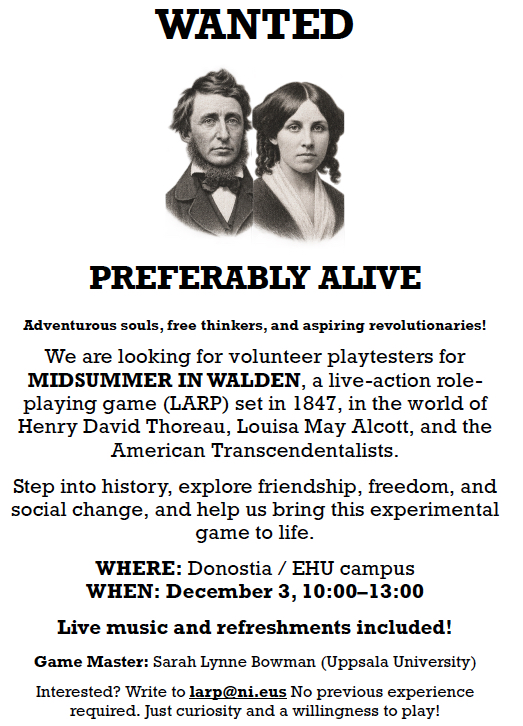
A gathering of extraordinary characters
Set in the summer of 1847, Midsummer in Walden brings together historical figures associated with American Transcendentalism, including Ralph Waldo Emerson, Lidian Emerson, Louisa May Alcott, and Margaret Fuller.
Players explore their relationships, ambitions, and contradictions, confronting dilemmas concerning freedom, care, gender, slavery, and political responsibility. Thoreau faces a central decision: whether to remain at Walden or return to society.
The game combines historical imagination, philosophical reflection, improvisational theatre, encounters with nature, and live music. Designed for 5 to 12 participants, it lasts approximately three hours, including preparation and reflection.
The team
With Antonio Casado from AKTIBA, two other researchers collaborate on this experiment, bringing complementary perspectives.
Sarah Lynne Bowman (Uppsala University) is an experienced larp researcher, educator, and designer. She leads the design process, drawing on her expertise in transformative role-playing experiences.
Brent A. Ferguson (Brunel University London) is a ludomusicologist exploring the relationship between music and games. His contribution investigates how live improvisational music can shape the atmosphere, emotions, and dramatic development of a larp.
The project is connected to Larpocracy, a European Horizon Europe research initiative exploring how live-action role-playing can contribute to democratic values and skills.
Why playtesting matters
Designing a larp is an unusual form of writing. We can prepare characters, relationships, conflicts, and scenes, but the experience only comes alive when people begin playing.
Participants interpret their characters, make decisions, form alliances, and discover possibilities the designers never anticipated. This makes playtesting essential.
We want to discover whether the characters generate meaningful interactions, whether everyone has sufficient agency, and whether the historical setting is accessible to newcomers. We are also experimenting with embodied environments, live music, and ways of moving between individual reflection and collective deliberation.
Playtesting helps us identify what works, what needs revision, and what surprises us. The participants’ experiences and feedback become part of the creative process.
Ultimately, we want to know whether stepping into the lives of nineteenth-century idealists can help us explore questions that remain urgent today: How should we live together? What do we owe one another? And how can individual convictions inspire collective change?