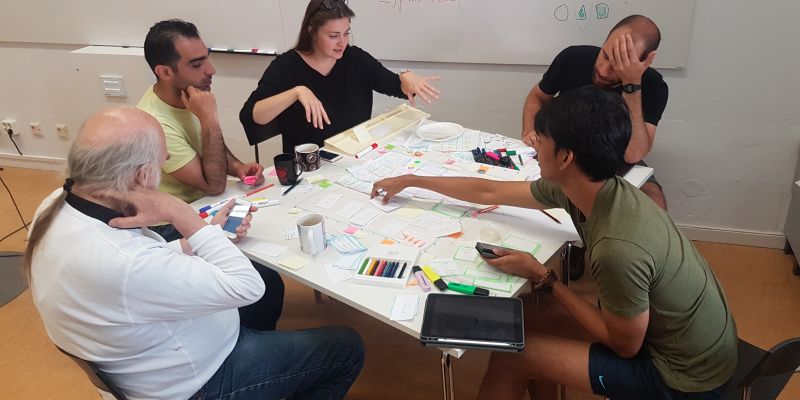
On 2-3 June, the University of the Basque Country will host the first InnoGameX workshop in Donostia – San Sebastián, bringing together colleagues from Uppsala University (Erik Olsson, Sarah Bowman, Alvin O’Sullivan), Ghent University (Femke De Backere) and EHU (Antonio Casado) to work on a shared question: how can the educational experience of the Innovation Game Summer Course be adapted, transferred and scaled across the ENLIGHT alliance?
The workshop builds on the Uppsala Innovation Game model, a summer course in which students use serious game design, design thinking and interdisciplinary teamwork to address complex societal challenges. The course has focused especially on health-related challenges, helping students develop gamified solutions in teams while learning about behaviour change, user-centred design, project management and professional presentation.
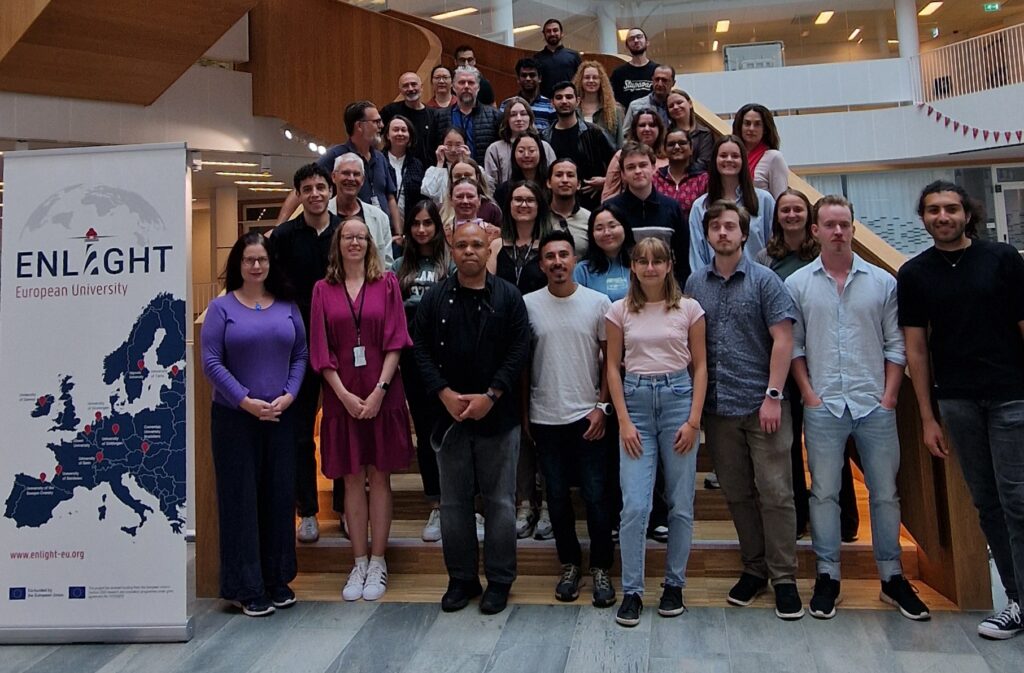
This is not a new experiment starting from zero. The Innovation Game course received the ENLIGHT Teaching and Learning Award in 2022, an academic recognition of its challenge-based, international and multidisciplinary approach. Uppsala University described the course as a setting where students work with experts and potential users to develop game-based responses to real challenges, using game design principles to influence motivation, knowledge, attitudes and behaviour.
The model has also shown that its scope is broader than health. When the course received the ENLIGHT award, Erik Olsson already pointed to the development of a related course focused on climate and environmental challenges, using the same educational concept in a different problem field. This matters for InnoGameX: the aim is to identify what can travel across contexts, and what should be adapted locally when the method is applied to sustainability, democracy, digitalisation, inclusion, health or social innovation.
The workshop will have two concrete goals. The first is to define the initial structure of an InnoGameX Playbook: a practical guide that can help other ENLIGHT universities understand, adapt and implement the core elements of the Innovation Game model. The second is to begin preparing the ground for a future Erasmus+ proposal, with a first discussion of possible work packages, partner roles, outputs and next steps.
Can we turn serious game education into a playbook?
On the first day of the workshop, participants will revisit the core of the Uppsala model: challenge-oriented behaviour change, serious games, design thinking, prototyping, intercultural teamwork, experiential learning and student community-building. They will then ask which elements should remain stable across future editions and which ones can be locally reinvented.
The second day will focus on implementation. The group will work on possible Erasmus+ work packages, the Playbook roadmap and future collaborations. A key milestone will be the development of a first Playbook prototype by the end of 2026, drawing on existing materials, the June workshop and the next Uppsala Summer School in August 3-14.
The final part of the workshop will take place at Tabakalera, the International Centre for Contemporary Culture in the center of Donostia, and will be open to invited stakeholders, including people working in academia, design, cultural mediation and related fields. This session will be a working space rather than a public showcase. Participants will discuss selected Playbook elements, such as a workshop script, a facilitation template, an evaluation tool or a prototype activity. The purpose is to expose the method to practical judgement and to raise interest for future collaborations with non-academic partners.
Recent ENLIGHT coverage of the Innovation Game has highlighted the intensity of the Uppsala experience: students from different countries, disciplines and backgrounds working under time pressure to produce serious game prototypes for global health challenges. It also shows one of the less visible strengths of the model: students learn not only by designing a game, but by navigating collaboration itself, including uncertainty, friction, testing, revision and shared presentation.
If InnoGameX succeeds, it will not simply document a course. It will translate a challenge-based educational practice into a set of usable materials: methods, workshop scripts, syllabi, reflection tools, evaluation practices and facilitation guidance. The ambition is modest in form but significant in effect: to help ENLIGHT partners create more spaces where students can work across disciplines, cultures and institutions on problems that do not fit neatly into one classroom.
The June workshop in San Sebastián is therefore a small but strategic step. It will not produce a finished Playbook in two days. It will set the ground, test the first pieces, define responsibilities and open the method to people who can help make it more robust. The real work will continue through 2026, with Uppsala, Ghent and EHU collaborating on a shared Beta version.