

[check out the Frequently Asked Questions section, updated regularly]
Leaving, Returning, and Renewal in the Concord Constellation
International Conference in Gandiaga Topagunea, Arantzazu (Oñati, Gipuzkoa), 3-5 June 2027
Convened by Henrik Otterberg (The Thoreau Alliance), Antonio Casado da Rocha (University of the Basque Country), and François Specq (Ecole Normale Supérieure de Lyon – University of Lyon)
Local Organizing Committee: Antonio Casado da Rocha, Maider Zilbeti Perez, Kepa Matxain Iztueta (University of the Basque Country)
Scientific Committee: Ronald Wesley Hoag (Emeritus, East Carolina University), Michael Berger (The Christ College of Nursing and Health Sciences, Cincinnati), Henrik Otterberg (The Thoreau Alliance)
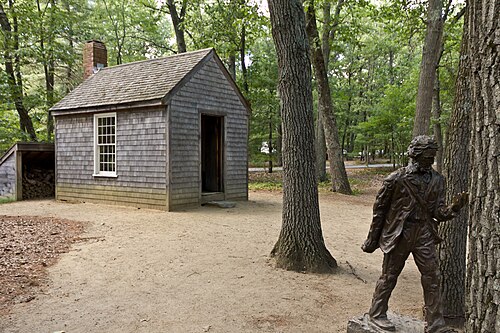
In September 1847, Henry David Thoreau left his cabin at Walden Pond after two years, two months and two days. Reflecting on that decision, he wrote: “I left the woods for as good a reason as I went there. Perhaps it seemed to me that I had several more lives to live.” In 2027, we mark the 180th anniversary of that departure, a moment that invites renewed attention not only to Thoreau’s retreat, but to what comes after it.
Specifically, this international conference proposes to explore how Thoreau and his circle of writers, thinkers, and reformers faced transition. While Walden is often read as a paradigm of withdrawal, Thoreau’s own framing emphasizes movement: leaving, returning, and renewal. The experience of retreat is not an endpoint, but part of a broader cycle through which individuals and communities transform themselves and re-engage with the world.
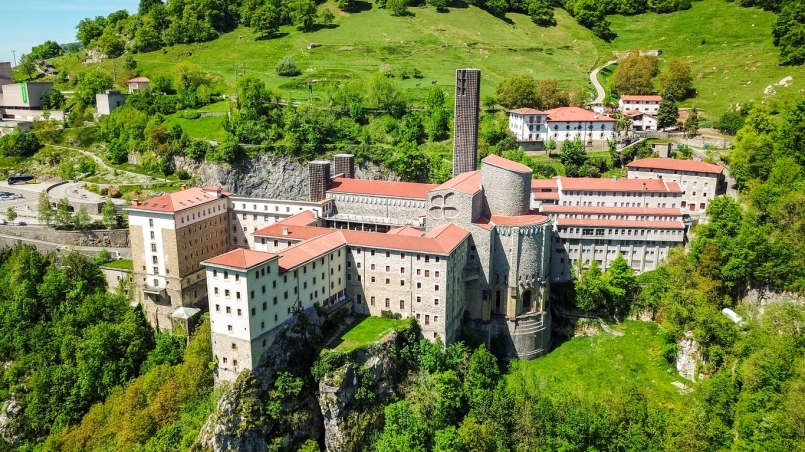
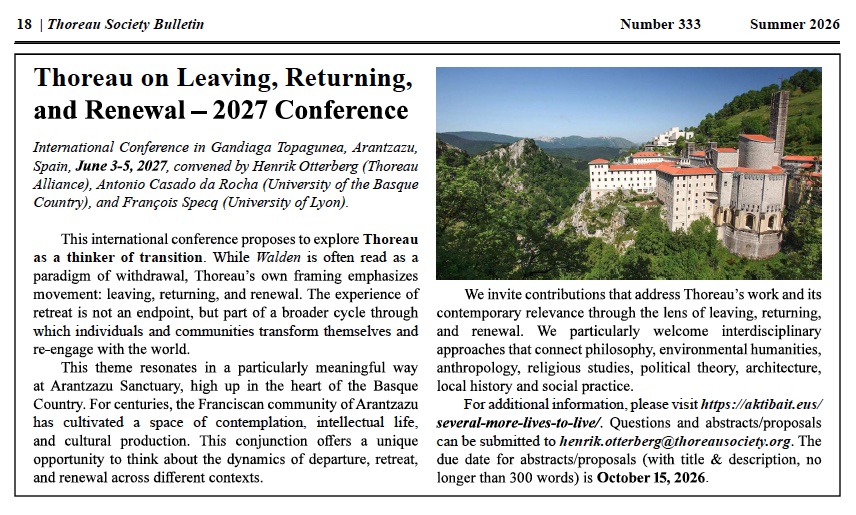
The theme resonates in a particularly meaningful way at Arantzazu Sanctuary, sitting at 700m in the heart of the Basque Country. For centuries, the Franciscan community of Arantzazu has cultivated a space of contemplation, intellectual life, and cultural production. This conjunction offers a unique opportunity to think about the dynamics of departure and renewal across different contexts. What does it mean to leave a place that has shaped one’s way of life? How do practices of retreat, whether philosophical, spiritual, or ecological, translate into new forms of engagement? What kinds of personal, social, and institutional transformations are made possible through such transitions?
We invite contributions that address Thoreau’s work, his contemporaries, and their contemporary relevance through the lens of leaving, returning, and renewal. We particularly welcome interdisciplinary approaches that connect philosophy, environmental humanities, anthropology, religious studies, political theory, architecture, local history and social practice.
Academic Program
Keynote Speaker
Lydia Willsky-Ciollo, associate professor of religious studies and director of American Studies at Fairfield University (Connecticut).
Papers and Work in Progress presentations
- The philosophical meaning of leaving in Thoreau’s work.
- Returning from Walden: re-engagement, responsibility, and public life.
- Renewal as a personal, social, or ecological process.
- Retreat and its afterlives: from solitude to community.
- The relationship between contemplation and action.
- Sacred places, sanctuaries, and their transformations.
- The cultural landscapes of monastic communities.
- Thoreau’s religion: spirituality, transcendentalism, and religious critique.
- Simplicity, frugality, and alternative forms of living after Walden.
- Democratic and ecological renewal inspired by Thoreau.
- Walking, returning, and inhabiting place.
- Thresholds, endings, and new beginnings.
- Thoreauvians in the Basque Country (Justo Gárate, Ramiro Pinilla, Koldobika Jauregi…)
Cultural Program
Some possibilities to be confirmed, depending on budget and availability:
- Guided Tour to the Basilica
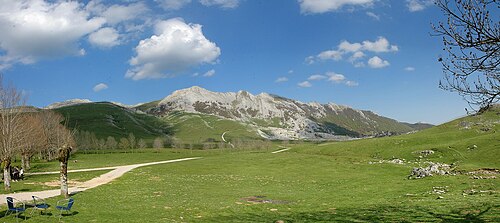
- Walk in Artaso Woods
- Climb to Aitzgorri peak (1.551m.)
- Live Action Role Playing game: Midsummer in Walden, 1847
- Visit to Local Shepherd School and Cheesemaking
- Visit to Local Winery
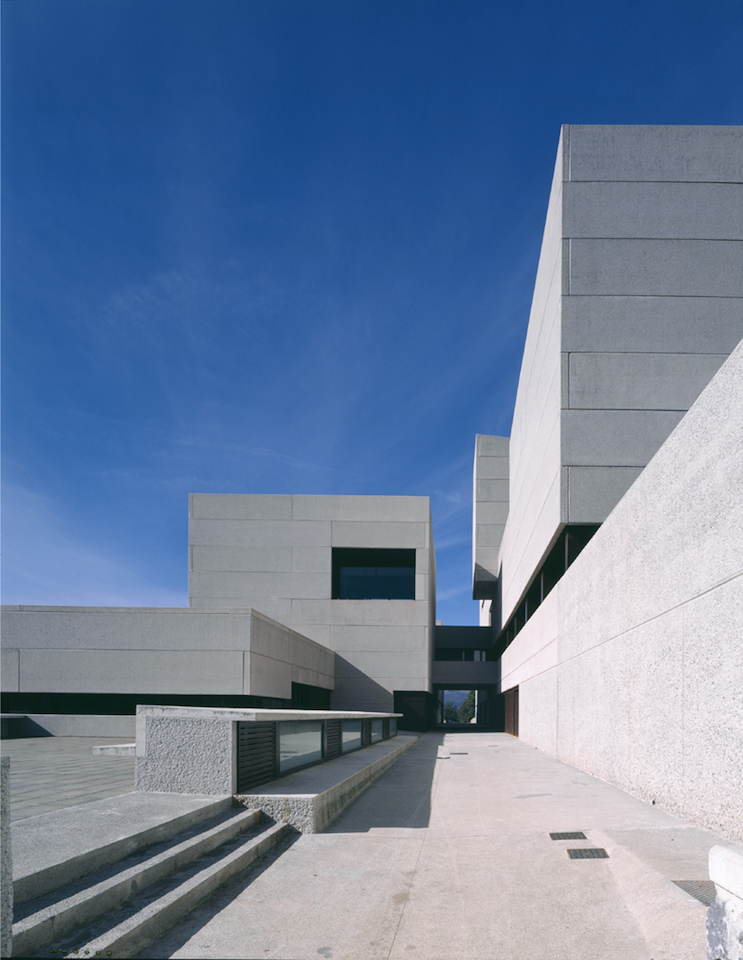
- Guided Tour to the Sancti Spiritus University (16th c.)
Provisional Schedule
Wednesday, June 2 | Arrival in Arantzazu
- Around 19:00: Meeting point in central Bilbao and transfer by bus to Arantzazu.
Thursday, June 3 | Conference Day 1
- 9:00–13:00: Academic sessions.
- 13:00: Lunch (self-organized: participants make their own arrangements, 3 different restaurants in Arantzazu).
- Afternoon: Free time and optional cultural activities.
- 20:00: Film screening: TBA.
Friday, June 4 | Conference Day 2
- 9:00–13:00: Academic sessions.
- Lunch, free time and/or cultural activities.
- 20:00: Official conference dinner.
Saturday, June 5 | Conference Day 3
- 9:00–13:00: Academic sessions.
- Lunch, free time and/or cultural activities.
- 20:00: LARP game: Midsummer in Walden, 1847.
Sunday, June 6 | Departure
- Morning: Return journey by bus to Bilbao, possibly including a cultural stop in Oñati.
FAQ
- What is the language of the conference? All activities will be done in English
- I am not a Thoreau scholar. Can I propose a paper? Yes, as long as it relates to the general topic of the conference and makes some reference to Thoreau or his close group of contemporaries. It will be blindly reviewed by the Scientific Committee.
- When is the deadline to submit a paper proposal? The CFP ended in November 15.
- Is there public transport to/from Arantzazu? Not really. There is only one bus service on Sundays from/to Oñati, the closest town. That’s why we are organizing a shuttle bus on June 2 and 6. Renting a car at the airport is a convenient option, providing flexibility for travelling to the conference venue and exploring the surrounding region. Alternatively, taxis can be booked in Oñati, at an estimated fare of €25–35 each way between Oñati and Arantzazu. Sharing a taxi with other participants could make this option more affordable, although availability and fares should be confirmed in advance.
- Do I have to stay in Arantzazu for the whole conference? Not necessarily, although it would be ideal. Check out the “Suggested Accommodation” section below.
Suggested Accommodation
Accommodation in Arantzazu is limited, so we recommend booking as early as possible. In addition to Hotel Sindika, Iraipe Arantzazu Hotel and the Aterpetxea hostel, you may consider Borda Aranzazu, which offers rural accommodation within walking distance to the conference venue. Alternatively, several hotels are available in Oñati, approximately 10 km from Arantzazu: Iraipe Ongi Hotel, Hotel Torre Zumeltzegi, Etxe Aundi and Soraluze Hotela. If you choose to stay in Oñati, renting a car is strongly recommended, as there is no regular public transport connecting the town with Arantzazu.
Acknowledgments
- The Thoreau Alliance
- Arantzazulab
- AKTIBA-IT
- Oñatiko Udala
- Eusko Jaurlartitza
- University of the Basque Country (EHU)
Contact
henrik.otterberg [at] thoreausociety.org